

Every flower. Every angle. Every batch.
Marvel automates the visual quality control of finished cannabis flower - grading with deep-learning AI and sorting with a puff of air.
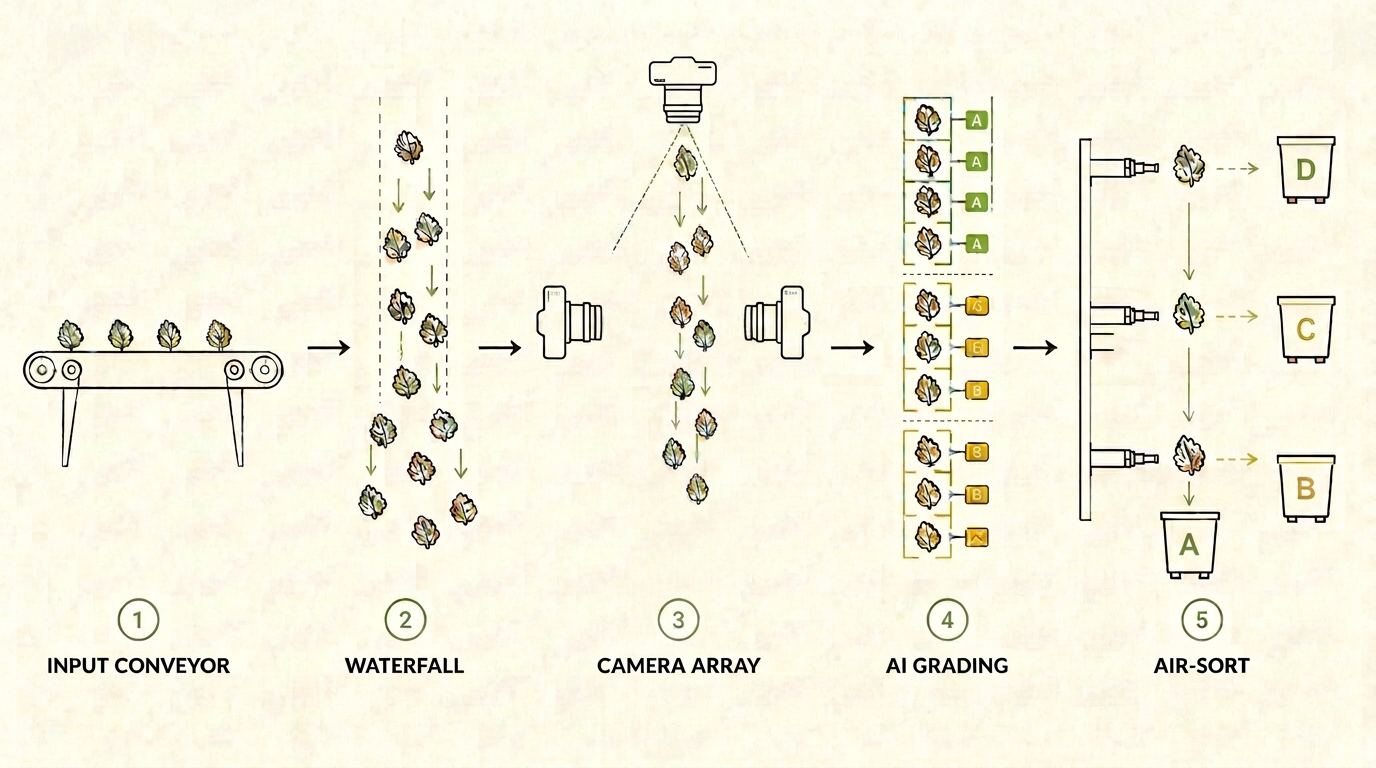
What happens inside
- 1. FeedFinished flower goes in a single input conveyor.
- 2. WaterfallFlower cascades off the conveyor in an even, single-layer curtain - so every piece is visible from every side, with no stacking or shadowing.
- 3. CaptureA high-speed camera array images each flower mid-fall from multiple angles - top, bottom, back.
- 4. GradeDeep-learning algorithms, trained on 1.2 million flowers, grade each flower against your criteria. Deep-learning inference runs on NVIDIA GPUs at full line speed - every flower graded in real time, no cloud round trip.
- 5. Air-sortFour output streams, configured to your operation: good flower passes straight through untouched, and precisely timed puffs of air route everything else into up to three additional streams you define.
A full Marvel line in a GMP facility: infeed, grading terminal, drum sorter, T-Zero.
The numbers on the nameplate
Up to 150 lbs per hour of finished flower. Grading accuracy averages above 80% and peaks up to 98% - which is exactly why Marvel is your QC system's first screen with humans on final judgment, not a replacement for them (we're direct about that). Every unit is CSA-certified at build. CE compliant. Patent pending. Running today in GMP-certified facilities. 40" wide, 80" long, 80" tall on casters at 750 lbs, run from a 19" touchscreen on a standard 120V circuit. Payback guaranteed inside six months under the managed model; fastest published: two weeks.
Download the Marvel cutsheet (PDF)
What Marvel checks
- Stem length - stem at the base of the flower
- Leaf length and count - untrimmed leaves on the flower
- Crow's feet - petioles left from fan leaf removal, and crow's feet at the base of the flower
- Structural stems - stems holding two or more flowers together
- Color - including discoloration and off-spec shades
- Mold and foreign material - flagged before it reaches a package
- Flat spots - flower that's been flattened or damaged in handling, caught and separated
- Strain separation - trained on your genetics, Marvel can detect and separate different strains, so a mixed lot gets unmixed instead of downgraded
- True size - width and length measured from multiple angles, so round and cone-shaped flowers both size accurately. Mechanical sorters can't do this.
Every criterion carries adjustable sensitivity classes, up to 7 levels on some - pass stems only if they're under 15% of flower size, for example - and criteria combine into conditions you set per strain, per season, per brand standard.
Two dimensions beat one
Conventional size sorters measure one dimension: flower falls through a gap or it doesn't. A large, cone-shaped flower drops through nose-first and lands in the smalls - sold at a discount it never earned. Marvel measures width and length from multiple angles, so every flower sizes by what it actually is, whatever its shape - set it to pass everything except flowers under half an inch, and that's exactly what happens.
What that's worth: in an on-site demo at a production facility, value-tier sorting recovered 37% of "smalls" as medium-or-larger flower and routed them to a higher-tier brand at a $150/lb price uplift. That's not sorting - that's re-pricing inventory you already own.
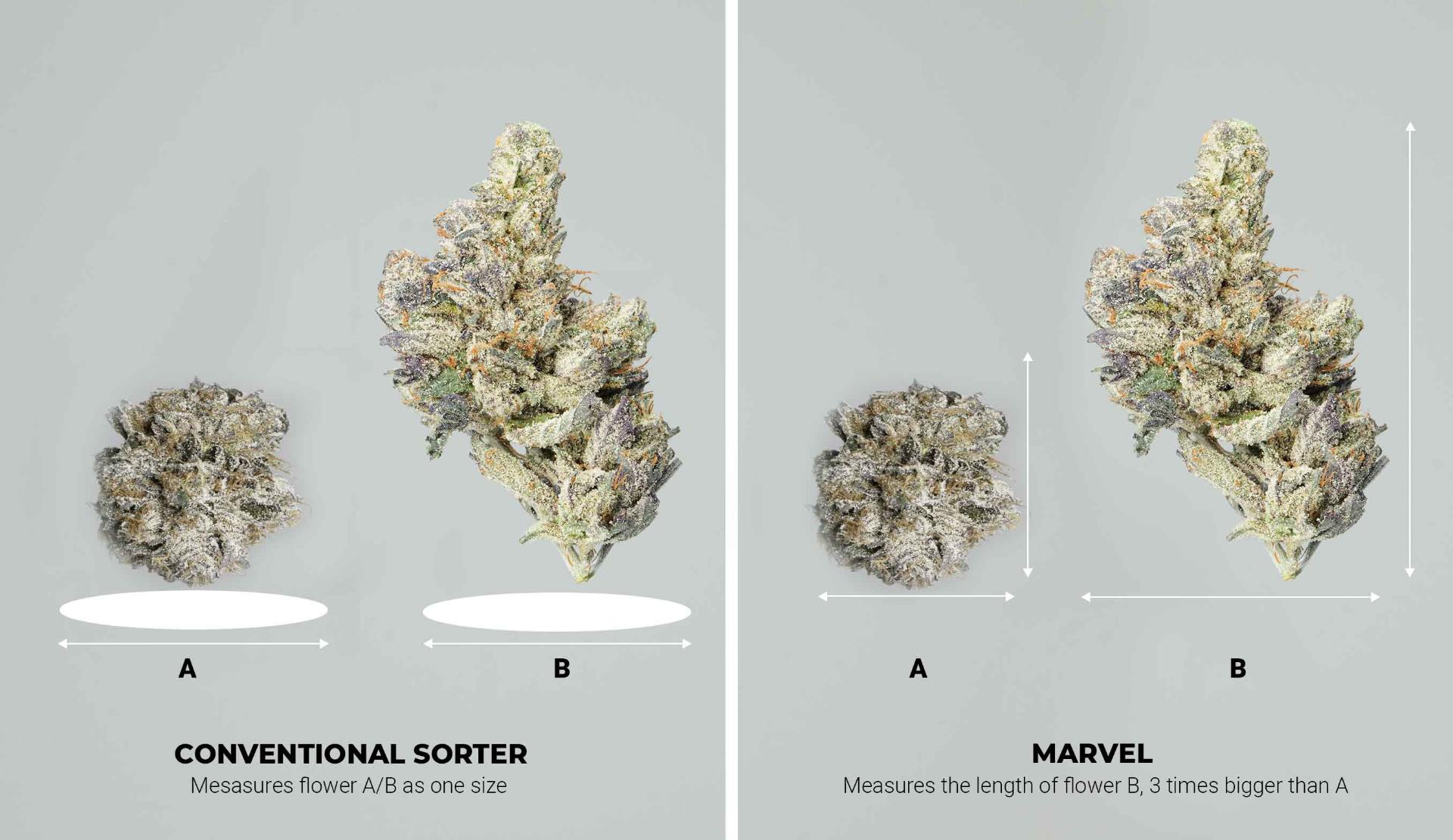
When a sorter can't tell a large flower from a small one, your size classes drift - and your premium grade leaks into the wrong bag.
People, mechanical sorters, and Marvel - compared
Three ways cannabis gets graded and sorted today, compared on the jobs that decide your margin.
Swipe to compare →
| Category | Manual QC line | Mechanical size sorter | Marvel |
|---|---|---|---|
| What it judges | Everything a trained eye sees - subjectively, and differently by person and hour | Size, in one dimension. Nothing else | Size, trim quality, color, structure, mold, and strain - every flower, from multiple angles |
| Grading accuracy | The best technicians run 60 to 80% over a shift; our measured head-to-head: 76.7% | Not applicable - it doesn't grade quality | Averages above 80%, peaks to 98% - with an 80% floor written into the guarantee |
| Throughput | About 5 lbs per person-hour at average flower sizes | Fast - at its one job | Up to 150 lbs per hour, graded and sorted |
| Hour nine vs minute one | Drifts - fatigue is the mechanism, not a character flaw | Consistent at sizing | The same call on the same flower, all shift |
| Round and cone-shaped flower | Sized fine, slowly | Mis-sized - one dimension can't see shape | True size from multiple angles; both shapes sort correctly |
| Mold and defects | Catches what fresh eyes catch; tired eyes miss | Ships them | Flagged before they reach a package |
| Strain separation | Only when visually obvious, and slowly | No | Yes - trained on your genetics |
| The record | Recollection, or paperwork someone had to do | None | Every flower scored, every lot reported - timestamped, retrievable - with sampled images synced for verification |
| Honest strengths | Judgment and nuance no machine replaces - which is why Marvel routes flagged flower to people, not the trash | Cheap, simple, fast. If size were the only thing that mattered, it would be enough | The first screen that never tires - with your people kept on final judgment |
Separation, not just pass/fail
- Cultivar separation - mixed lots sorted back into their original genetics across a multi-month recovery. The operator's own team put separation accuracy at 97%.
- Color separation - sort by color profile to protect brand consistency or pull off-spec flower before it ships.
Know the grade of every lot you produce
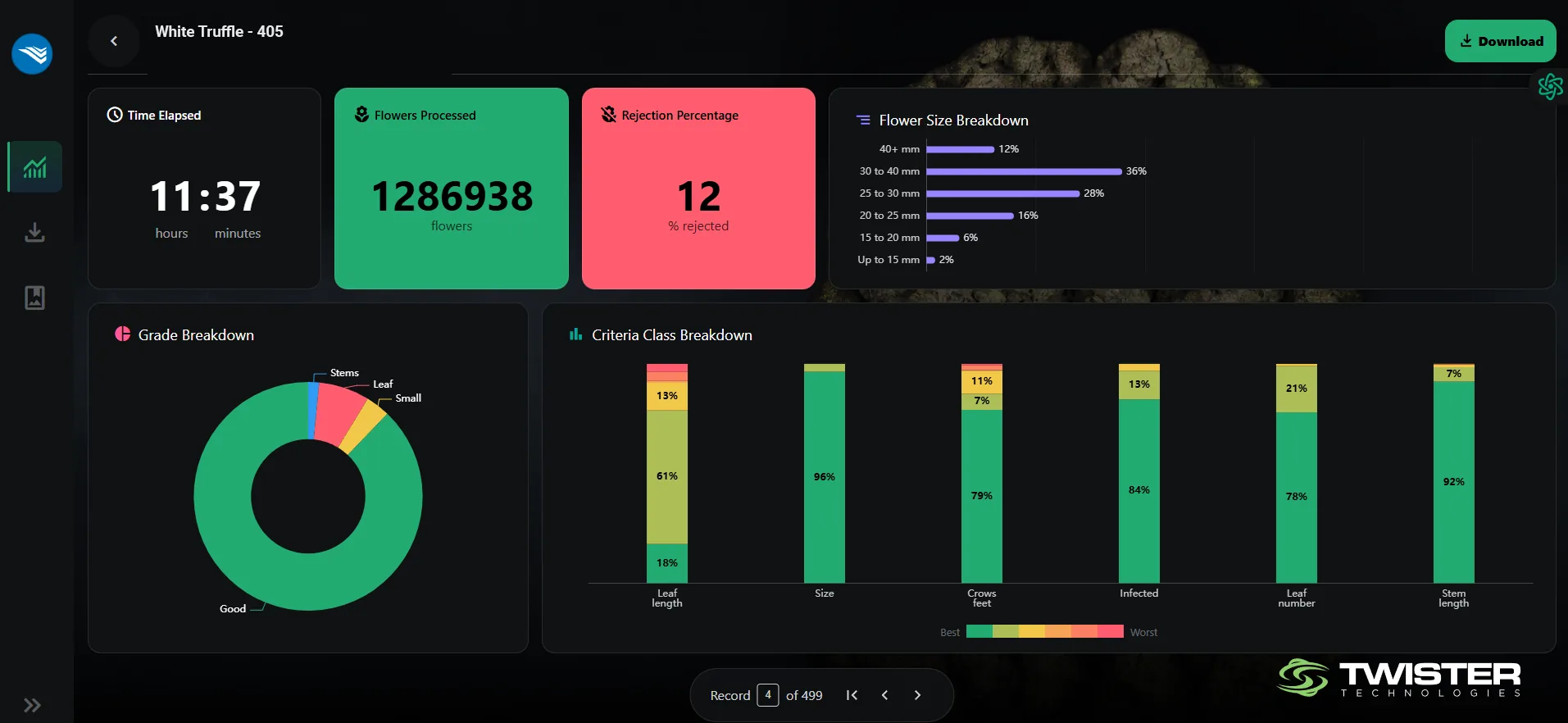
Marvel scores every flower and every batch, and the Marvel Portal keeps the receipts: every grade call and every report, logged per lot in the cloud, with sampled images synced for verification. Each report carries total flowers processed, the size distribution, the class distribution for every graded characteristic, and the percentage sorted into each output. Drill into a single flower or review a 100 lb lot at a glance, in real time or months later. It's the quality record GMP-minded operators and bulk buyers have been asking for.
Marvel is the brain of the loop, not another station on the line
Over-trimming is the single biggest yield killer in automated post-harvest, and a sorter alone can't fix it: by the time flower reaches a sorting machine, the yield is already in the trim bin. Marvel attacks it upstream by closing a loop. It grades everything, the data shows how light your trimming machine can actually run, the line opens up, and Marvel verifies the result: every batch, every strain, every season. We call it Intelligent Trimming, the trim line adjusted from real grading data instead of set-and-hope. With GEN 3 the loop closes physically: flower that needs rework gets routed back to a re-trimmer.
Marvel GEN 3
GEN 3 moves from grading to deciding: it evaluates trim quality and contamination, determines the optimal next step, and executes it - auto-routing flagged flower to re-trim without a human touching it, at up to 150 lbs of finished flower per hour. Third generation in, and every machine in the fleet runs the newest brain.
Intelligent Trimming: the line that corrects itself
Every cultivar lands on your trim line different. How it was grown, how it was dried, how dense the flower set - all of it changes how flower moves through a trimmer. A line tuned for last month's harvest is mistuned for this one, and static settings can't hold a spec against that kind of variability.
Today: Marvel grades every flower in real time, so the line runs on data instead of guesswork. Over-trimming showing up in the grades? Speed the flow, back off the suction, meter the infeed. Adjustments happen batch by batch, driven by what the flower actually looks like coming out. That's Intelligent Trimming.
Where this is going: the loop closes. Twister Autopilot™ (Autopilot for short), a system in development that runs on Marvel, takes control of the automation across the trimming line: infeed conveyors, trimmer settings, size sorting, and grading, with infeed volume metered by Oracle, our volumetric scanner. It detects drift and adjusts on the fly, holding your output spec without a hand on a dial, tuned to one objective: your gross margin, not just your throughput. It arrives the way everything does on the managed model: as an upgrade to the installed fleet. The operations running Marvel when it lands are the ones it lands on.
The Marvel cut sheet
Dimensions, throughput, power, and compliance specs - for your engineering and procurement team.
Download the cut sheet (PDF)What happens next
- 1. Discovery call (30 min). Your current process - throughput, team, labor cost per pound, where QC happens today - and honest fit assessment.
- 2. Data collection and value stream mapping. Our team gathers your production data and walks your line with you.
- 3. Tailored ROI case. The savings model that gets frozen in writing behind the payback guarantee.
- 4. Paid demo on your flower. Weights verified live, on your scale. Demo fee credits toward your package when you proceed.
- 5. Install, tune, run. Managed service - your team operates, we keep it tuned by strain and season.
That's the Keirton Blueprint. Useful to have handy for the first call: recent yield numbers by strain, and your all-in cost to buck, trim, and sort per pound.
See it run on your flower.
A 30-minute discovery call. We'll cover throughput, criteria, and how Marvel fits into your existing line.