Mobius M108 vs Twister: Why Adjustable Geometry Preserves More Yield
On dry flower, the Mobius M108 vs Twister question comes down to one mechanical detail most spec sheets skip: how close the flower sits to the cutting edge, and whether you can change it.
Mobius M108 vs Twister: which design protects yield on dry flower?
In a Mobius M108 vs Twister comparison on dry flower, the variable that decides usable yield is mechanical: how close the flower sits to the cutting edge while it is trimmed, and whether the operator can change that distance. The M108's cutting geometry is fixed. A Twister's is adjustable, so it can hold the flower farther from the blades and preserve more bud structure, which is exactly where yield is won or lost.
What the trimmer comparison usually misses
When cultivators compare trimmers, the conversation starts with speed, cut quality, and labor savings. One of the most important variables is harder to see: how close the flower gets to the cutting edge while it is being trimmed.
That distance matters. The smaller it is, the closer your flower is to being polished, with bud structure coming off in the process. Yield is not only lost when a machine removes leaves. That is the job, and it is what careful hand trimming does well. Yield is also lost when the machine takes bud structure along with those leaves.
The Mobius M108 introduced a genuinely new approach to wet trimming when it launched. Its thin cable tumbler, thin bedknives, and tight spacing let wet, pliable flower get very close to the cutting edge, which produced a tight trim with little leaf left behind. Wet flower is forgiving, so any structural damage was easy to overlook. Dry trimming is a different story. Dry flower is lighter, more brittle, and far more vulnerable to breakdown and over-trimming as the weak structural stems snap, especially once smaller buds enter the machine. The same geometry that works wet becomes less forgiving dry.
The Twister T-Line, the T-Zero, T2, and T4, was built to control that distance instead of fixing it. That single difference is why these machines consistently return more usable yield on dry flower.
How the cut actually happens
On both the M108 and a Twister, the cut happens below the tumbler, at the point where the bedknife meets the rotating helix blade. The flower is supported by the tumbler above that cutting zone.
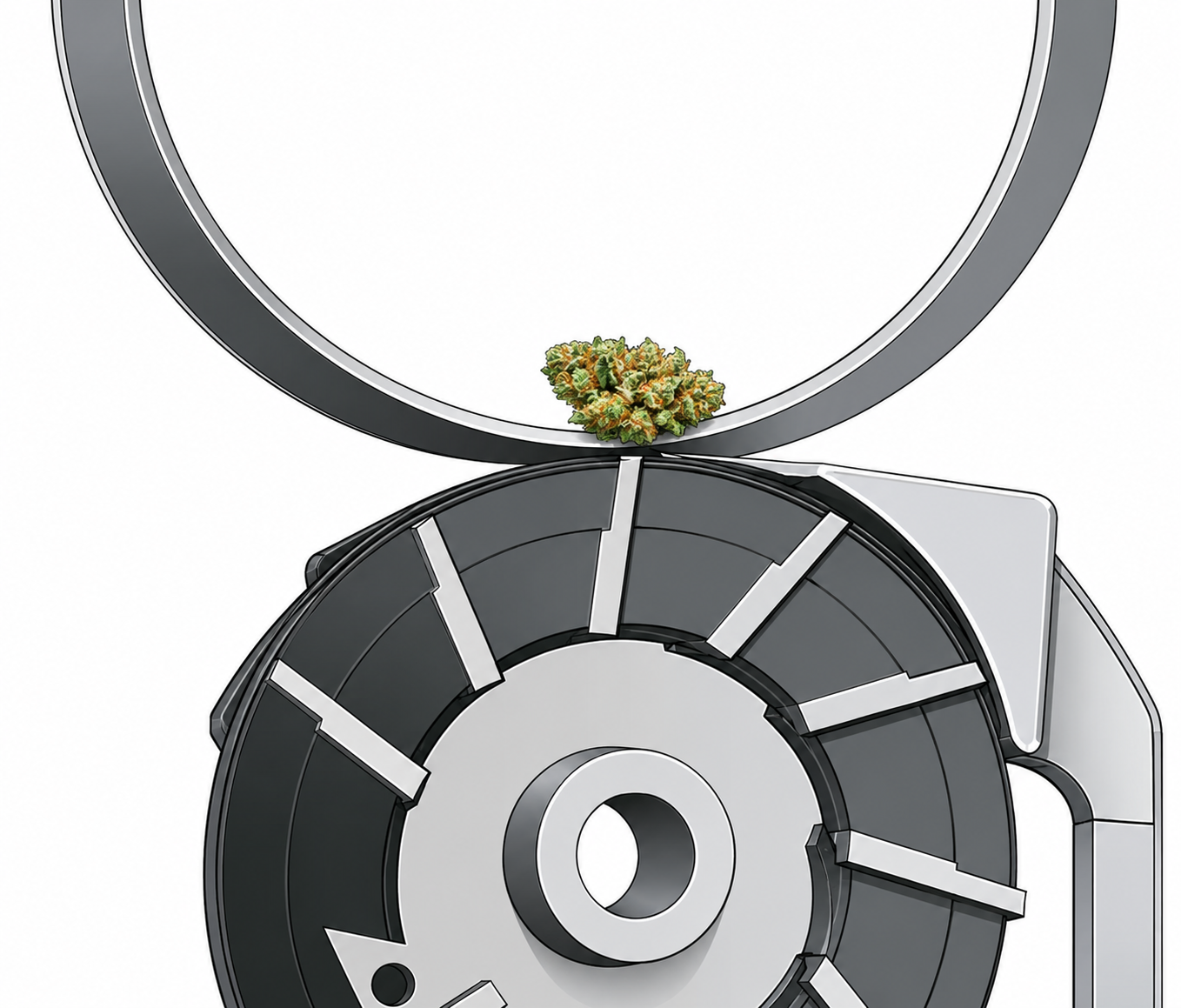
A common misconception is that the tumbler does the cutting. It does not. The tumbler's job is to carry material safely over the cutting zone while rolling it to expose untrimmed areas of each flower. That makes one question decisive: how close is the flower to the cutting edge?
Picture trimming a hedge while holding the trimmer two feet from the branches. You barely touch anything. Now move the trimmer within a few inches. Every small movement becomes aggressive, and tiny changes in position remove much more material. Trimmers work the same way. The closer the flower sits to the blades, the more leaf you remove, and the easier it becomes to cut into the bud itself instead of only the protruding sugar leaves.
Why tumbler slot width changes your yield
Blade spacing is only part of the story. The width of the tumbler slots also sets how close the flower gets to the blades.
Think of a tire resting on the two parallel rails of a rack. When the rails sit close together, the tire rides high. As they spread apart, the tire sinks deeper between them. Cannabis band sorters work on the same principle: as the bands travel around the machine and spread apart, flower settles deeper between them until it drops through.

The same thing happens inside a tumbler. Each flower is supported by the edges of the tumbler slot. As the slot gets wider, the flower settles deeper into the opening. Since the blades sit directly beneath the tumbler, every bit the flower drops moves it closer to the cut. The consequences are significant. More bud structure gets exposed to the blades, which increases the odds of removing sellable material and translates directly into lost weight. Even when weight loss is minimal, flowers pick up trimming blemishes, because the blades start contacting the outside of the bud rather than only the protruding leaf. Dark calyxes and foxtails get clipped, leaving bright green scars and dragging down visual quality.
The Mobius M108 uses a fixed 0.25" tumbler slot, so every flower settles to a depth set by that relatively wide opening. A Twister can run the same 0.25" slot when it suits the material, but for dry trimming it is often better to run a narrower 0.1875" slot. The narrower slot supports flower higher in the tumbler, holds it farther from the blades, and allows a more selective trim.

It is hard to overstate how much this one distinction matters. It is the same flower on both sides, but in the M108's wider slot far more of the bud protrudes through the tumbler toward the blades. A large portion of that exposed structure gets removed, and that lost material is yield and bag appeal going straight into the trim.
Why small flower takes the biggest hit
Slot width matters even more with smaller flower. Back to the tire rack: a smaller tire drops deeper between the same pair of rails.

A smaller bud does the same thing in a tumbler slot, and it compounds the problem. The wider slot already sits flower closer to the blades. Smaller flower then sinks farther into that slot, exposing even more of the bud to the cutting zone. This is one of the biggest reasons experienced operators avoid running smalls through an M108, if they run them at all. The issue is not simply that small flower is delicate. It is that an already aggressive geometry becomes more aggressive as flower size drops. The result is lower sellable yield, more clean-cut calyxes and scarring, and greater inconsistency across different flower sizes.
The geometry, measured: M108 vs the T-Zero
We measured the dimensions that set where the flower sits relative to the blades. On the M108, three of them are fixed: a 0.025" bedknife, a 0.0315" cable tumbler, and a 0.05" gap between the underside of the tumbler and the top of the bedknife. Stack those up and the flower sits about 0.1065" from the cutting edge, with no way to change it.
It is worth being precise here, because the M108 is genuinely adjustable in other ways. Tumbler speed, blade speed, suction, and tilt all adjust. What does not adjust is the cutting geometry itself: the slot width, the blade gap, and the bedknife thickness are fixed. Those are the dimensions that decide how close the flower gets to the blade, and on the M108 you are stuck with them.
A Twister T-Zero changes those exact dimensions.
| Dimension | Mobius M108 | Twister T-Zero |
|---|---|---|
| Bedknife thickness | 0.025" (fixed) | 0.07" |
| Tumbler wall / cable | 0.0315" cable | 0.062" wall |
| Tumbler-to-bedknife gap | 0.05" (fixed) | ~0.06", adjustable 0.03–0.08" |
| Tumbler slot width | 0.25" (fixed) | 0.25" to 0.1875", adjustable |
| Flower-to-cutting-edge distance | ~0.1065" (fixed) | ~0.19", adjustable |
| Net effect on dry flower | Flower held close to the blade, no way to tune | More clearance and operator control, tuned to preserve yield |
Each change moves the flower farther from the cutting zone before it ever reaches the blades, and lets the operator match the machine to the material. The thicker bedknife alone increases the minimum distance between the cutting edge and the flower above it. The adjustable blade gap lets operators fine-tune that distance from 0.03" to 0.08". The narrower slot keeps flower riding higher in the tumbler instead of dropping into the cutting zone where structure gets shaved off. The T2 and T4 share this adjustable geometry with the T-Zero, so the same principle scales across the line.
Dimensions measured directly from an M108 and a Twister T-Zero. On wear parts, Mobius lists its blades, tumblers, and gaskets as consumables outside warranty coverage, and its own manuals cite a 200-hour service life for those parts. Twister covers its bedknives, helix blades, and tumblers against manufacturing defects, and they are built to last well over ten times longer. If a covered part is defective, it gets replaced.
Why this shows up as higher yield
Higher yield does not come from trimming less. It comes from trimming more precisely. A Twister removes protruding leaf while minimizing contact with the flower itself, and that shows up as measurable advantages.
Better flower support
Narrower, adjustable slots keep flower higher in the tumbler and reduce exposure to the blades. This matters most with over-dried, small flower.
Better geometry
A thicker bedknife and adjustable blade gap give real control over how aggressively the machine trims.
Better adaptability
Different sizes, densities, moisture levels, and cultivars are handled by adjusting the machine instead of forcing everything through one fixed geometry.
Better preservation
Less contact with the flower means higher sellable yield, better calyx preservation, fewer cosmetic blemishes, and improved bag appeal.
The numbers back this up. Across customer sites, the adjustability of a Twister delivers a consistent 5 to 10 percent yield improvement over competitor machines. In our published machine-vs-machine breakdown, a T-Zero PRO holds a 75/25 flower-to-trim ratio against a 70/30 ratio on an M108 line, and at commercial volume that five-point swing toward flower is worth hundreds of thousands of dollars. You can read the full machine-vs-machine payback math in Part 2 of our T-Zero PRO ROI series.
You can also read the result in the trim stream. A pile of micro-buds mixed into the trim is a clear sign of over-trimming. In our side-by-side GMO sample tests, a structure-heavy cultivar that punishes any trimmer, a tuned T-Zero PRO kept micros low and finished flower within a few points of hand trim. That is the outcome adjustable geometry is built to protect.
The bottom line
The Mobius M108 deserves credit for introducing an innovative trimming system, especially for wet trimming. On dry flower, its fixed geometry works against the operator. A fixed 0.25" slot, fixed blade geometry, and a cutting point held close to the supported flower make the machine more aggressive than it needs to be, and that gets worse as flower size drops.
A Twister was engineered around a different philosophy. Instead of cutting as fast as possible, it controls how the flower is supported before it ever reaches the blades. Adjustable tumbler geometry, tuned blade positioning, and real operator control let the machine remove leaf while preserving the thing that actually pays: the flower. When you are selling premium cannabis, every gram counts and every scar costs you bag appeal. A trimmer that consistently preserves bud structure instead of shaving it off does not just produce nicer-looking flower. It produces more of it.
Frequently asked questions
Does the Mobius M108 or a Twister trim with higher yield on dry flower?
A Twister typically returns higher usable yield on dry flower. The reason is mechanical: its adjustable tumbler geometry holds flower farther from the cutting edge, so it removes leaf while preserving more bud structure. Across customer sites, that is a consistent 5 to 10 percent flower-yield improvement over competitor machines like the M108.
Why does tumbler slot width affect yield?
The tumbler slot supports each flower above the cutting zone. A wider slot lets flower settle deeper, closer to the blades, which exposes more bud structure to the cut and increases both weight loss and cosmetic scarring. A narrower slot holds flower higher and farther from the blades for a more selective trim.
Can you adjust the cutting geometry on a Mobius M108?
No. The M108 adjusts tumbler speed, blade speed, suction, and tilt, but its cutting geometry is fixed. The slot width, blade gap, and bedknife thickness cannot be changed, and those are the dimensions that set how close the flower sits to the blade. A Twister makes all of them adjustable.
Why is small flower harder on the M108?
Smaller flower sinks deeper into the same fixed slot, moving it even closer to the blades. On an already aggressive geometry, that compounds over-trimming, so smalls tend to lose more yield and pick up more scarring. It is why many operators avoid running smalls through an M108.
How much more yield does a Twister deliver than an M108?
Twister field data shows a consistent 5 to 10 percent higher flower yield than competitor machines. In a published machine-vs-machine example, a T-Zero PRO holds a 75/25 flower-to-trim ratio versus 70/30 on an M108 line. At commercial volume, that five-point swing toward flower is worth hundreds of thousands of dollars in top-line revenue.
Run a sample test on your hardest cultivar, or get a walkthrough of the T-Line and the yield math for your operation.
Explore the T-Zero PRO