Trimmer Tumblers: How to Choose the Right One for Your Flower
The tumbler slot width you run sets how deep each bud sits and how much leaf and structure comes off, directly proportional to your yield. Here is how to choose a narrow, standard, or wide slot for your Twister Trimmer.
Which tumbler slot width should you run?
You want the tumbler that will optimize the balance between trim quality, yield, and a distant 3rd, throughput. The right tumbler slot width comes down to your flower's size, moisture and defoliation practices. A wider slot lets each bud settle deeper toward the blades, while a narrow slot keeps the flower further from the blades. Run a narrow slot when flower is small or over-dried, a standard slot for most flower, including large, dry flower in a normal moisture range, and a wide slot for large wet flower or dense outdoor flower that has not been heavily defoliated. Generally, wide slot tumblers will trim tighter; they can reduce visual quality and character; they can reduce yield; but they can trim faster. Narrow slot tumblers will generally trim looser; they will maintain more visual quality and character; they will maintain better yield; but they can trim slower.
How big is the difference between narrow and wide?
The three sizes are closer than they sound. The narrow (3/16"), standard (1/4"), and wide (5/16") slots step up by 1/16" each time, about the thickness of a penny. Picture a standard wooden pencil: that is right around 1/4", the standard slot. One penny narrower is the narrow slot. One penny wider is the wide slot.
Those are small moves, but they change the trim more than the numbers suggest, because of where they leave the flower sitting. The wider the slot, the deeper the bud drops into it, the same way a ball drops lower between two rails as you spread the rails apart as you see on some flower size sorting machines. Since the blades sit directly below the tumbler, a bud that rides deeper sits closer to the cutting edge, and more of it gets trimmed. We break that mechanism down further against competitor machines in our deep dive on tumbler geometry and yield.
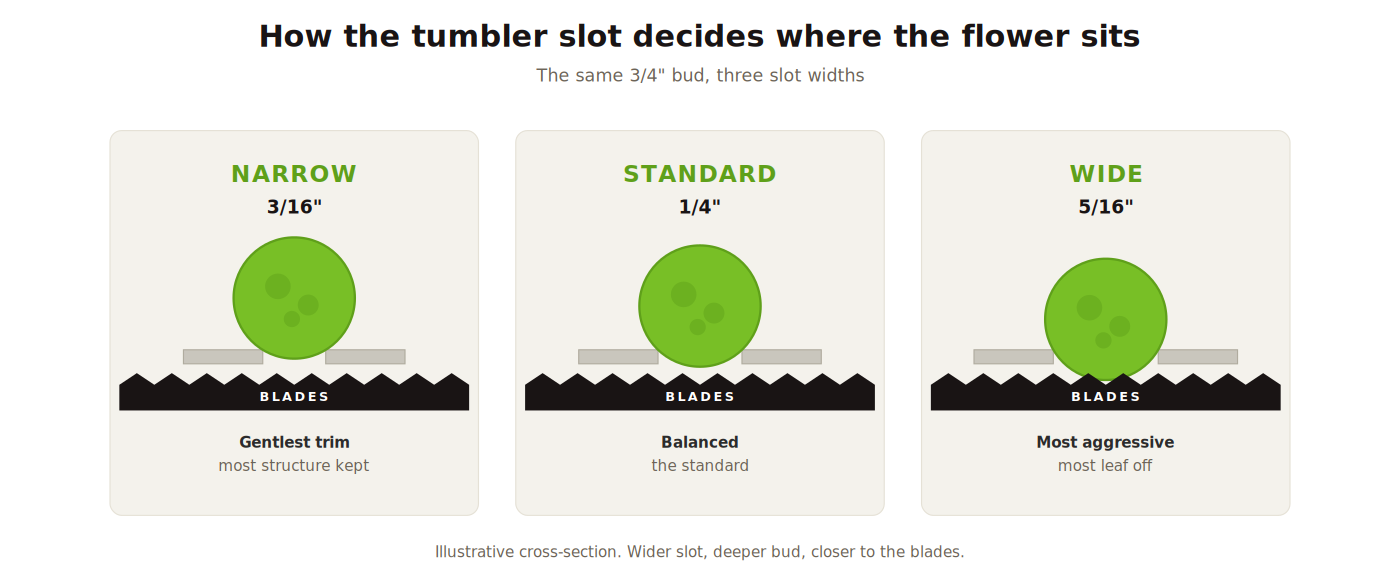
So the tumbler you run is really a control for how aggressively the machine trims. It is one of the fastest levers you have for changing what comes off the line, and how much of what you see in the trim is leaf versus bud structure.
Matching the tumbler to your flower
Once you know that a wider slot sits flower deeper and trims harder, picking a tumbler is mostly about reading your material.
The narrow slot holds flower highest in the tumbler, farthest from the blades, for the most selective trim. It is the one to run when flower is small or over-dried, which is exactly the material that over-trims easily. Dry flower can run here or on the standard slot, but the narrow slot is the safer choice once buds get small or moisture drops below 8-9%. If you are seeing too much structure in the trim, or clean-cut calyxes on your finished buds, or scars, going narrower pulls the flower up and away from the cut. This will improve flower quality and character, and protect your flower-to-trim ratio.
The standard slot is the one to reach for on most flower, and it is where we tell most operators to start. It handles a wide range of sizes and moisture levels, including large dry flower in the normal 10 to 13% moisture window. The place to be careful is small or over-dried flower: large, larfy buds down around 7% moisture are fragile, and a standard slot can over-trim them, so that is when it is worth stepping down to the narrow slot. When you are running two machines in tandem, it is often best to run the standard slot on the first machine for the bulk of the trim, then the narrow slot on the second for a gentle finishing pass that cleans up what is left without over-working the bud. This is often the recommended setup on a T-Zero as well: the first tumbler runs the standard slot, and the second runs the narrow slot. This setup helps achieve great results in many scenarios, providing ideal quality while maximizing yield and maintaining strong throughputs.
The wide slot lets flower settle even deeper and trims more aggressively, which is what you want with large wet flower, or dense outdoor flower that has not seen much defoliation. That material is big, robust, and carries a lot of leaf, so it can take the deeper position without giving up structure, and the wider opening keeps large, sticky buds tumbling through instead of hanging up. It is not the slot for small wet flower, though: small buds sink too far into a wide slot and over-trim, so keep those on the standard slot. If you are seeing too much leaf left behind on large, robust, or undefoliated flower, going wider takes more off.
The pattern is simple. If the machine is taking too much, go narrower. If it is leaving too much, go wider. Each of these tumblers is a physical change you can make on a Twister T-Zero, T2, or T4, so you can tune the machine to the flower instead of forcing every batch through one fixed opening.
| Tumbler | Best for | Where the flower sits | Quality & yield | Throughput |
|---|---|---|---|---|
| Narrow | Small or over-dried flower; fragile, low-moisture buds | Highest, farthest from the blades | Best; looser, gentler trim keeps character | Slower |
| Standard | Most flower, including large dry flower at 10–13% moisture | Middle | Strong; balanced trim | Balanced |
| Wide | Large wet flower, or dense undefoliated outdoor flower | Deepest, closest to the blades | Lower; tighter trim, less character | Faster |
| Rule of thumb | Taking too much? Narrower. Leaving too much? Wider. | Wider slot, deeper flower | Narrower protects quality & yield | Wider trims faster |
Does your machine offer different tumbler configurations to match your processing goals?
All of this only helps if your machine actually lets you change the tumbler. Some trimmers ship with a single, fixed tumbler: you get whatever slot width the manufacturer built in, and you end up adapting your flower to the machine instead of the other way around. Others, like the Twister T-Line, let you swap between narrow, standard, and wide tumblers and tune the geometry to the batch in front of you.
That flexibility matters because your flower is never just one thing. Size, moisture, and defoliation change from strain to strain and room to room, and the tumbler that protects yield on a large, wet outdoor run is the wrong one for over-dried indoor smalls. A machine that offers the full range lets you optimize quality, yield, and throughput for each cultivar you run, while a machine with fixed geometry locks you into one trade-off for everything. So before you invest, it is worth asking a simple question: can this trimmer change its tumbler, or am I stuck with one setup for every batch?
Frequently asked questions
Can I run dry flower through a standard tumbler?
Yes. Large dry flower in the normal 10 to 13% moisture window runs well on the standard slot. The care point is small or over-dried flower: large, larfy buds down around 7% moisture are fragile and can over-trim on a standard slot, so step down to the narrow slot for those.
When should I use the narrow tumbler slot?
Use the narrow slot for small or over-dried flower, and any time buds are fragile or moisture has dropped below 8-9%. It holds flower higher in the tumbler and farther from the blades, which preserves structure and reduces over-trimming on delicate material.
When should I use the wide tumbler slot?
Use the wide slot for large wet flower or dense outdoor flower that has not been heavily defoliated. That material is robust and carries a lot of leaf, so it can sit deeper for a more aggressive trim, and the wider slot keeps large buds moving through the tumbler. It is not the right slot for small wet flower, which sinks too deep and over-trims, so keep small buds on the standard or narrow slot.
What tumblers should I run on two machines in tandem?
Run the standard slot on the first machine for the bulk of the trim, then the narrow slot on the second for a gentle finishing pass. The first pass does most of the work, and the second cleans up what is left without over-trimming.
Why does a wider tumbler slot trim more aggressively?
The wider the slot, the deeper each bud settles into it. Because the blades sit directly below the tumbler, a bud that rides deeper sits closer to the cutting edge, so more of it is removed. A narrower slot holds flower higher and farther from the blades for a gentler, more selective trim.
Does tumbler slot width affect throughput?
Yes. A narrow slot holds flower farther from the blades, so less material is trimmed on each pass and throughput tends to be lower. A wide slot sits flower closer to the blades and trims more per pass, so throughput climbs, with the standard slot in between. In practice the yield you protect is usually worth more than a few points of capacity, so slot width is rarely chosen on throughput alone.
Can every trimmer switch between narrow, standard, and wide tumblers?
No. Some trimmers have a single fixed tumbler, so you are locked into one slot width for every batch. Others, like the Twister T-Line, let you swap between narrow, standard, and wide tumblers to match each cultivar. If matching slot width to your flower matters to you, confirm the machine can change its tumbler before you buy.
Tell us what you are running and we will help you dial in the right tumbler setup for your operation.
Talk to a Twister Expert